10 February 2009

Orals Proposal: A Before and After Snapshot

This is only the first part of the proposal, and it is unfinished, but it's coming along fairly nicely. It's not as bad in any case.

Before:
For years—at least since John Block Friedman’s 1981 book The Monstrous Races in Medieval Art and Thought and Jeffrey J. Cohen’s debut on the scene in the early 1990s—monster theory has been overwhelmingly concerned with reading monsters as marginal figures that demarcate the cultures that create them. Freddy Krueger, Frankenstein’s monster, the Giant of Mount St Michel, the Grendelkin, or Polyphemus mark the boundaries of what is and is not possible. Perhaps more importantly, they serve as outer boundaries of what an individual can or cannot think, speak, or do. [1] In short, they have usually been read as “the primary vehicle for the representation of Otherness in the Middle Ages”; [2] in fact, on this there is a rare and surprisingly widespread consensus.

This widespread consensus, however, has made for an awkward moment in monster theory. Such agreement has left many unsure as to how we should proceed, and some have focused their attentions on other projects. Indeed, conversations with fellow members of the BABEL Working Group such as Cohen, Eileen Joy, and Karl Steel have shown that while monsters are still a source of discussion, scholarly interest in them is beginning to wane in favor of attendant issues (hybridity, sexuality, medieval concepts of the human, etc.). As many who were once heavily involved in monster theory have foreseen, academic agreement quickly becomes academic stagnation. Thus, what was once the study of characters who could petrify with fear is itself in danger of sinking into the swamp and becoming petrified by consensus.

What have not been agreed upon—or even hotly debated—are the functions of monsters as boundary figures. We may agree that as symbols of the Other they demarcate, and we may even agree (though to a lesser extent) on how they go about doing so. But to my knowledge no serious, sustained interrogation has been performed on their function as means of community-formation. Boundary figures by their very nature create an inside and outside. As the Lacanian imago immediately introduces the structural possibility of self/not self, so too does the monster introduce the structural possibility of us/them. [3] This interpretation denies any positivist model for definition, and it is the basis on which Hayden White forms his idea of “ostensive self-definition by negation.” [4] He argues that cultures are largely unable to create an overall definition of what they are and so point to a thing that they are not. Following White’s theory of how the concept of “wildness” served to define “human” or “civilized,” we may read monsters as boundary figures that aid in the creation of a culture’s (negative) definition—of defining what it is by demarcating what it is not. [5]

[1] For limits on thought, see Jeffrey J. Cohen’s “The Limits of Knowing: Monsters and the Regulation of Medieval Poplar Culture.” Medieval Folklore 3 (1994): 1-37. For limits on speech, see David Williams’ Deformed Discourse: The Function of the Monster in Mediaeval Thought and Literature. Montreal: McGill-Queen’s UP, 1996. For limits on action, see John Block Friedman’s The Monstrous Races in Medieval Art and Thought. Syracuse: Syracuse UP, 2000.
[2] The Use of Monsters and the Middle Ages.” SELIM: Journal of the Spanish Society for Medieval English Language and Literature 2 (1992): 47-69. p. 49 (Emphasis mine).
On this consensus, see also: Noël Carroll, The Philosophy of Horror (New York: Routledge, 1990); Albrecht Classen, “Medieval Answers to the Strange World Outside: Foreigners and the Foreign as Cultural Challenges and Catalysts,” in Demons: Mediators Between This World and the Other, eds. Ruth Petzoldt and Paul Neubauer (Frankfurt: Peter Lang, 1998); Edward J. Ingebretsen, “Monster-Making: A Politics of Persuasion.” Journal of American Culture 21.2 (1998): 25-34; and Franco Moretti, “Dialectic of Fear,” in Signs Taken for Wonders: Essays in the Sociology of Literary Forms, trans. Susan Fischer, David Forgacs, and David Miller. (London: Verso, 1988).
[3] Lacan associates this self/Other split that occurs during the mirror stage with Freud’s Innenwelt and Umwelt. See Lacan’s “The Mirror Stage” in Ecrits: A Selection. Trans. Alan Sheridan. New York: Norton, 1977.
[4] Tropics of Discourse: Essays in Cultural Criticism. Baltimore: Johns Hopkins UP, 1978. pp. 151-52.
[5] US Supreme Court Justice Potter Stewart produced a lasting example of ostensive negative definition in 1964. Admitting that he could not define pornography, he then stated “I know it when I see it, and the motion picture involved in this case is not that” (Jacobellis v. Ohio. 378 U.S. 184. Supreme Ct. of the US. 22 June 1964).


After:

Back in 1936, the venerable J.R.R. Tolkien urged Anglo-Saxonists to rethink their approach to Beowulf. Up to this point the poem had been considered a useful historical document and a poor poem, but Tolkien thought that—in order to understand the poem as a poem we ought to examine its monsters. They were not, as so many had previously thought, “an inexplicable blunder of taste”; instead, he argued they were “essential, fundamentally allied to the underlying ideas of the poem.” [1] And so began the genealogy of monster theory in medieval literature.

Over the years the approaches and theories have changed, mostly in step with overall academic trends. In 1936 Tolkien thought study of Beowulf’s monsters would lead to an understanding of its literary merits and its generic placement. Currently, medieval monster theorists are more concerned with analyzing monsters as marginal, boundary figures. The general (but not total) shift in approach may have moved from a formalist and structuralist bent to post-structuralism and cultural criticism, but the focus of the approach has never wavered. Monsters.

Monsters—be they medieval creations like the Grendelkin or Chretien de Troyes’ Harpin, or their more contemporary brethren like Dracula or Freddy Kreuger—may be characterized by a single tenet: monsters are what they are (ontologically, functionally, culturally) because they do not play by physical or cultural rules. [2] That notion is acultural, ahistorical, but what is wholly dependent on specifics of culture and history is how monsters break these rules. Beowulf’s Grendel and Bram Stoker’s Dracula are not the same in their goals or their methods, but their transgressions still adhere to the dual categories. Grendel has glowing eyes, is as large as thirty men and has steel-like claws; Dracula is (un)dead and can turn into a bat. Grendel will not or cannot speak, is inimical to the weapons and armor so important to the humans of the poem, and creates a perverse mockery of the feast hall by making men the meal; Dracula drains the Life Force from his victims and unleashes female sexuality in a way that threatens the Victorian sensibilities of Seward, Holmwood, and Van Helsing.

Each transgression (whether it be Grendel feasting on human flesh or Dracula turning into a bat) necessarily marks a boundary, for without a line there is no crossing, no transgression. For Jeffrey Jerome Cohen—and the other medieval monster theorists who largely follow his lead—the boundary is imagined by the creator(s) of the monster. It is through their nightmares that these people and their cultures tell us about themselves. It is through their monsters that they tell us what they believe should not be possible, what they believe one should not think, speak, or do. [3] In short, monsters really do the job to which they are etymologically linked: they point out and show the line between “us” and “them,” this side and the Other side. [4] Such a function was as true for the Victorian era as it was for our era of examination, the Middle Ages. It has lead Cohen to pronounce monsters “the primary vehicle for the representation of Otherness in the Middle Ages,” a statement on which there is widespread consensus. [5]

This consensus deals with a functional analysis of monsters. Gone are the days of trying to identify Grendel or Harpin ontologically; what they actually were is of less interest than analysis of what they do in texts and the effects of those actions on a broader, extratextual scale. We may agree that as boundary figures, monsters symbolize the Other they demarcate, conjuring the specter of its existence event as they attempt to dissuade serious consideration of it. Such a reading of monsters is nothing new and relies heavily on the Lacanian theory of the imago introducing the structural possibility of the Other as a integral part of identity formation. [6] The notion that monsters work to construct what cultural critic Hayden White calls “ostensive self definition by negation” has gained traction over the years, and most monster theorists have accepted—to varying degrees—the premise that communities, largely unable to craft a positivist model, point to examples of what they are not in order to create a definition of what they are. [7] For White, examples of medieval wildmen served to define what authors meant by “civilized,” “us,” or even “human.” This theory is easily extended to monsters to explain their function in the creation of a specific community’s (negative) definition by providing didactic exempla of what is not a part of that community.

[1] “Beowulf: The Monsters and the Critics.” Proceedings of the British Academy 22 (1936): 245-95. p. 261.
[2] Jeffrey Jerome Cohen. “Monster Culture (Seven Theses).” Monster Theory: Reading Culture. Ed. Jeffrey Jerome Cohen. (Minneapolis: U of Minnesota P, 1996), 6.
[3
] For limits on thought, see Jeffrey J. Cohen’s “The Limits of Knowing: Monsters and the Regulation of Medieval Poplar Culture.” Medieval Folklore 3 (1994): 1-37. For limits on speech, see David Williams’ Deformed Discourse: The Function of the Monster in Mediaeval Thought and Literature. Montreal: McGill-Queen’s UP, 1996. For limits on action, see John Block Friedman’s The Monstrous Races in Medieval Art and Thought. Syracuse: Syracuse UP, 2000.
[4] The Latin monstro means to “show” or “point out” and is the root of the Modern English “demonstrate.”
[5] The Use of Monsters and the Middle Ages.” SELIM: Journal of the Spanish Society for Medieval English Language and Literature 2 (1992): 47-69. p. 49 (Emphasis mine).
On this consensus, see also: Noël Carroll, The Philosophy of Horror (New York: Routledge, 1990); Albrecht Classen, “Medieval Answers to the Strange World Outside: Foreigners and the Foreign as Cultural Challenges and Catalysts,” in Demons: Mediators Between This World and the Other, eds. Ruth Petzoldt and Paul Neubauer (Frankfurt: Peter Lang, 1998); Edward J. Ingebretsen, “Monster-Making: A Politics of Persuasion.” Journal of American Culture 21.2 (1998): 25-34; and Franco Moretti, “Dialectic of Fear,” in Signs Taken for Wonders: Essays in the Sociology of Literary Forms, trans. Susan Fischer, David Forgacs, and David Miller. (London: Verso, 1988).
[6] Lacan associates this self/Other split that occurs during the mirror stage with Freud’s Innenwelt and Umwelt. See Lacan’s “The Mirror Stage” in Ecrits: A Selection. Trans. Alan Sheridan. New York: Norton, 1977.
[7] Tropics of Discourse: Essays in Cultural Criticism. Baltimore: Johns Hopkins UP, 1978. pp. 151-52.
US Supreme Court Justice Potter Stewart produced a lasting example of ostensive negative definition in 1964. Admitting that he could not define pornography, he then stated “I know it when I see it, and the motion picture involved in this case is not that” (Jacobellis v. Ohio. 378 U.S. 184. Supreme Ct. of the US. 22 June 1964).

07 February 2009

Reaching up to Touch the Floor

The title of this post is a reference to Peter Elbow's Writing Without Teachers. In it, he tells an allegorical story about a land in which the people could not touch the floor without great difficulty. It was difficult because the accepted approach to touching the floor was to reach upwards as high as you might; so pervasive was the reach-up ideology, that the only time people could be taught to touch the floor was indirectly--by tying their shoes "without sitting down and shaking [their] hands around at the same time" (13).

So, yeah. That's sort of how I feel at this point, like I've been going about this thing the wrong way. I've tightened up to the point that it's difficult for me to think creatively about my proposal. I've no trouble thinking critically; thanks to a lot of great support from my friends, I think I have a good idea of the areas that were problematic (and on some of these, there was new and different widespread concensus!). What I'm having trouble with is remedying the problem areas. I know what's wrong, but I'm so overwhelmed by the project and its argument that I can't hold any 2 portions of it in my head for more than a few seconds...and forget trying to re-examine the relationship between 2 or more portions of the proposal. That is far beyond the scope of someone who just today forgot one of the key primary sources for this research project (remembered Harpin but forgot Chretien when talking to Eric Lutrell today). So I'm going to work only on this paragraph tonight--and probably for just a few minutes. I imagine a lot of it is about to go by the wayside...

Original:
This widespread consensus, however, has made for an awkward moment in monster theory. Such agreement has left many unsure as to how we should proceed, and some have focused their attentions on other projects. Indeed, conversations with fellow members of the BABEL Working Group such as Cohen, Eileen Joy, and Karl Steel have shown that while monsters are still a source of discussion, scholarly interest in them is beginning to wane in favor of attendant issues (hybridity, sexuality, medieval concepts of the human, etc.). As many who were once heavily involved in monster theory have foreseen, academic agreement quickly becomes academic stagnation. Thus, what was once the study of characters who could petrify with fear is itself in danger of sinking into the swamp and becoming petrified by consensus.
Well, even I have to admit that this paragraph is pretty bad. Let's see what I can do here.

Revised:
Academic consensus is a rare bird, and one of the reasons for this is the stagnation that often follows in its wake. Broad-scale agreement kills discussion and ceases movement: we relinquish our places at the vanguard where we advanced new and risky ideas to bivouac in familiar territory where we produce prescriptive statements. Our sense of inquiry leaves us.

One might argue that the momentum of monster theory has begun to wain, our forward progress has slowed. Perhaps each scholar associated with monster theory has begun to keep one eye open for more attractive, vibrant areas of inquiry. Perhaps when there is nothing left to argue, there is nothing left to say. Perhaps--though we be blind men touching different parts of the proverbial elephant--we have decided that is it, indeed, an elephant. We are far from done, for we have not even begun to understand how the elephant works. We may agree on the definition and even function of monsters in medieval texts, but that is just the "what"; we have only begun to ask the "how" and the "why" of that function.
I started fading there at the end. But it provokes lots of questions in my head: How do monsters function as boundary figures? Is it by dint of their physical description/appearance? Their actions? Their rupture of "normal" narrative events? Their troubling and overshadowing of other, more formal aspects of the works that contain them? Their peculiar cultural markers (such as cannibalism, silence/gibberish, clothing)?

Do these aspects themselves reinforce the boundary via fear? If so, how is fear employed? Is it fear of the monster and of the Other (psychoanalytic) or fear of ending up like the monster who always suffers the same fate in what amounts to a morality tale (structuralist)? Is it fear of what is necessarily on the other side of that boundary? Is what is on the other side of the monster what is actually deeply-seated in all of us (Lacanian extimacy)?

I think the waters are sufficiently muddied...but I'm no closer to a cogent prospectus. Great.

06 February 2009

1200 is for pussies, we do the 8th century

This, according to my own calculations, is the single greatest utterance by an Anglo-Saxonist in the history of ever. I am forever in Eileen's debt, for this has brightened my day, given me direction in my life, and reinvigorated my academic drive.

Monsters are the Washington Generals of Literature

I guess my committee chair was right: there are some ginormous structuralist underpinnings in this project. I was re-reading Cohen's introduction to Monster Theory (for the eleventy billionth time), and I realized that I am assuming a general plot for monsters within texts. It may not be the main plot: it could be an incidental story or the overarching theme of the work, but it almost always turns out the same. The general story arc for monsters is that they threaten and then lose. It's so simple that many people have relied on it without stating it explicity or, having stated it explicitly, did not place it within its proper theoretical context.

But it is a structuralist precept in the classic sense. Grimm, Propp, et al. often got bogged down in detailing minute variations of story types--trying to create some sort of Linnean taxonomy of every single type and variant of that type. It not only was so ambitious as to be impossible, but it seemed to be of limited use even in its ideal form. On the other side of the register, Jung, Campbell, et al. often generalized similarities to the point that they were so vague and all-encompassing that one saw them in everything. How does one make a story without a protagonist and antagonist? How does the protagonist then not become a variant of (or response to) The Hero?

But as Edward Ingebretsen once wrote (I paraphrase): the monster exists to be killed, we must be the one who kills it, and it can never be our fault. Whether that monster is a personification of a cultural anxiety (Frankenstein's monster, Dracula, Freddy, witches) or a partial reification of an actual personage (the Japanese in WWII propaganda posters, OJ Simpson, Native Americans), the story plays out the same way. The monster threatens. We, the people, resist and fight (sometimes via proxy in the hero, sometimes not). The monster dies by our hand. Our anxieties are termporarily assuaged.

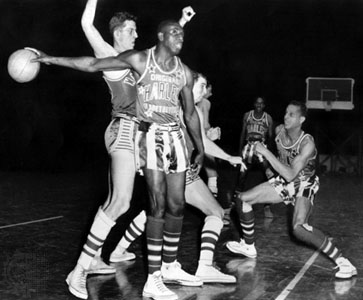
It's not a very interesting plot line, but it's just a terrifically general skeleton plot--a thing that Tolkien once complained was, no matter the text, either "wild, or trivial, or typical." The thing about it is its ability to provide comfort. I think it functions in the same way our favorite movies do. There's no doubt that Danny Kaye and Bing Crosby are going to save the General's lodge in White Christmas, and there's no doubt that Marvin's going to be shot in the head in Pulp Fiction. But I keep watching these movies even though I know what will happen. We keep re-reading books even though we know what's there. It's not because we want to see if Bing convinces Rosemary Clooney he's not a bad guy or if Beowulf can pull out one more battle with Grendel. No, we return for the show, not the score. In this sense, I think monsters really are like the Washington Generals. You go to watch the Harlem Globetrotters beat the snot out of them, and you want to see how it will be done, but God help the Generals if they actually win one because they'll make the kids in the stands cry. Same with monsters. They exist to lose to the hero or to us. They help us exorcise or excise our anxieties in a safe way.

05 February 2009

Every Time I Think I'm Out...They PULL me Back in

My Orals proposal was rejected!


Soooooo, since it bounced like a Bernie Madoff check, I guess I have my work cut out for me. I need to figure out what the hell's confusing about this thing; the trouble is, like my students, I'm so close to it that I can't see the confusing parts, the logically flawed parts. It seems to make total sense to me, but not to a group of non-medievalists who don't know what the hell monster theory is.

I was already pretty concerned about oversimplifying monster theory as a movement, so it's ironic that it was decided I didn't explain it clearly/simply enough. Maybe I should contextualize monster theory within the post-structuralist and cultural criticism movement, but I footnoted the proposal pretty heavily. I didn't think I had to explain much in the way of who two of the biggest names in medieval monster theory are; I mean, I think I introduced my sources pretty well (not the USSC Justice, but that was an parenthetical, explanatory note, not a supporting/resource note).

I also heard that they were confused a bit by the primary texts--that because they weren't medievalists, they didn't quite follow what I planned to do with/to Harpin and Grendel. I'm not at all sure what to do about this problem; I was unaware that I was writing to a general academic audience. I thought I was writing to my chair since he and other medieval-types will be on the Orals Committee, but now I have to do the most difficult thing a writer can attempt (besides adapting Ulysses to the screen). I have to think like a non-medievalist, and I honestly don't know if I can do that. I've put a call out to medievalists and non-medievalists for some help in identifying the problems, but I can't wait. I have to start out now, so I'm going to take it bird by bird, as Anne Lamott would say.

First off, the initial paragraph.


Original:
For years—at least since John Block Friedman’s 1981 book The Monstrous Races in Medieval Art and Thought and Jeffrey J. Cohen’s debut on the scene in the early 1990s—monster theory has been overwhelmingly concerned with reading monsters as marginal figures that demarcate the cultures that create them. Freddy Krueger, Frankenstein’s monster, the Giant of Mount St Michel, the Grendelkin, or Polyphemus mark the boundaries of what is and is not possible. Perhaps more importantly, they serve as outer boundaries of what an individual can or cannot think, speak, or do. In short, they have usually been read as “the primary vehicle for the representation of Otherness in the Middle Ages”; in fact, on this there is a rare and surprisingly widespread consensus.
Redux:
Back in 1936, the venerable J.R.R. Tolkien urged Anglo-Saxonists to rethink their approach to Beowulf. Up to this point, the poem had largely been used as a historical document rather than a poetic work, but Tolkien thought we should not ignore the monsters of the poem. They were not, as so many had previously thought, "an inexplicable blunder of taste"; instead, he argued they were "essential, fundamentally allied to the underlying ideas of the poem" (261). And so began the genealogy of monster theory in medieval literature.

Over the years, the approaches and theories have changed with the shifting sands of academic trends. Tolkien thought a closer examination of the monsters of Beowulf would lead to a better understanding of its literary merits, its generic placement, and the theme of a hero's courage. Currently, medieval monster theorists are concerned less with these aspects of the poem; at least since John Block Friedman’s 1981 book The Monstrous Races in Medieval Art and Thought and Jeffrey J. Cohen’s debut on the scene in the early 1990s, monster theory has been largely concerned with reading monsters as marginal figures that demarcate the cultures that create them.

The general shift in approach may have moved from a formalist bent to post-structuralism and cultural criticism, but the focus of the approach never has. Monsters--be they medieval creations like the Grendelkin or the Giant of Mount St Michel or their contemporary brethren like Frankenstein’s monster, Dracula, or Freddy Kreuger--mark boundaries. For Tolkien it was the boundary of what is and is not a poem, a lyric, or a hero. For Cohen and other contemporary monster theorists, it is the boundary of what is and is not possible and of what an individual can or cannot think, speak, or do. In short, contemporary monster theory has usually read monsters as “the primary vehicle for the representation of Otherness in the Middle Ages”; in fact, on this there is a rare and surprisingly widespread consensus.

There, that can't be worse than before...or can it?


02 February 2009

Yoga...

It's not just for burnt-out hippie pot-heads anymore. I mean, wait. It's just...dammit.

If you're gonna do yoga, don't do it on the beach. That's just the opposite of calming, I think.

So get yourself a yoga mat, and then make sure and recycle it when you stop doing yoga 2-3 months later because you're that damn trendy.